The TP-Link RE715X is a dual-band Wi-Fi 6 range extender designed to carry an existing network into rooms where router coverage is weak.
This tp link ax3000 review looks at its bandwidth ratings, placement needs, Ethernet port, and EasyMesh fit so you can judge whether it addresses your home’s coverage problem.
TP-Link RE715X Review Summary
The quick verdict
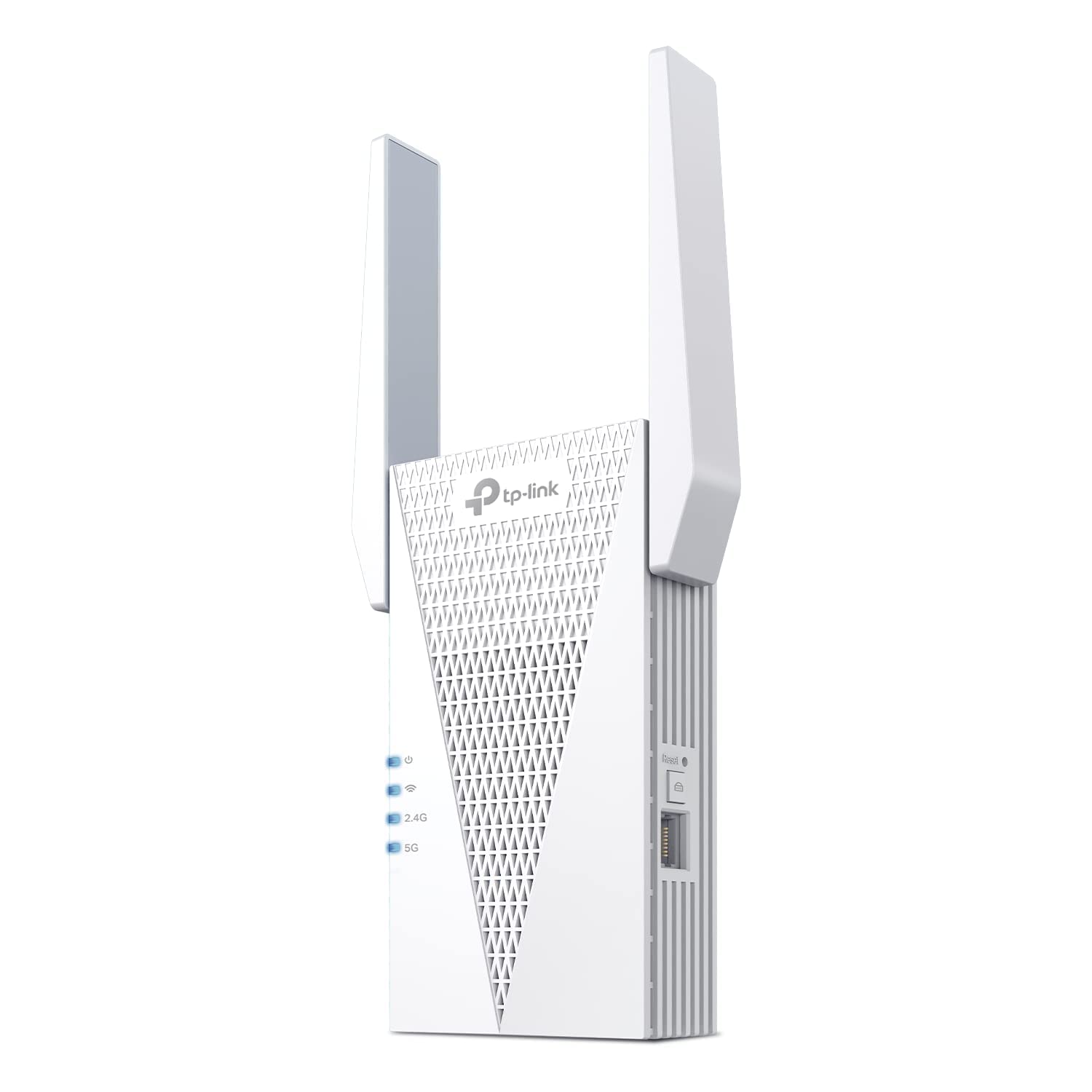
4,000+ ratings
Read Amazon ReviewsTP-Link RE715X
A Wi-Fi 6 range extender for households seeking broader coverage, EasyMesh compatibility, and a wired connection option for a nearby device.
- Dual-band Wi-Fi 6 with maximum rated speeds up to 2404 Mbps on 5 GHz and up to 574 Mbps on 2.4 GHz.
- Coverage figure of up to 2,400 square feet and support for up to 64 devices.
- Two high-gain directional antennas and Beamforming technology for extending the signal.
- EasyMesh compatibility with compatible routers; not compatible with mesh systems such as Deco.

Pros
- High maximum dual-band rate ratings for a Wi-Fi 6 extender.
- Directional antennas and Beamforming are aimed at improving signal reach and reliability.
Consider before buying
- An extender works with the signal it receives and does not increase the internet connection’s underlying speed; the maker cautions that actual speeds may be 50% or less of current speeds.
- The coverage and maximum rate figures are conditional upper limits, so walls, distance, placement, and other conditions affect results.
Read the full review summary
The RE715X combines advertised maximum link rates of up to 2404 Mbps on 5 GHz and 574 Mbps on 2.4 GHz, two high-gain directional antennas, and Beamforming.
Its coverage figure is up to 2,400 square feet, with support for as many as 64 devices.
Those are useful design targets for a larger home or a busy network, though real results depend on placement, walls, distance, and the signal the extender receives from the router.
It is a coverage tool, not a way to raise the speed supplied by your internet plan. TP-Link cautions that wireless extender speeds may be 50% or less of current speeds.
The RE715X is most compelling when a router already reaches the extender’s chosen location reasonably well and you need to extend that connection further; people with an EasyMesh-compatible router can also use that network approach, while Deco mesh systems are explicitly incompatible.
The buying factors
TP-Link RE715X Scorecard
Editorial scores reflect listed features and buyer fit; they are not laboratory measurements or customer ratings.
Coverage design
Two directional antennas, Beamforming, and a stated coverage area up to 2,400 square feet give it a strong feature set for extending an existing signal.
Dual-band capacity
The 5 GHz band is rated up to 2404 Mbps and the 2.4 GHz band up to 574 Mbps, with actual rates depending on conditions.
Device support
Support for up to 64 devices suits a connected household, although the device limit does not guarantee equal performance for every client.
Wired flexibility
A gigabit Ethernet port supports a wired device connection and can provide the wired input for Access Point mode.
Mesh integration
EasyMesh compatibility can help integrate it with a compatible router, but it does not work with TP-Link Deco mesh systems.
Setup and placement
The Tether app, setup guidance, and intelligent signal indicator give buyers practical tools for configuring and locating the extender.
Key Features and Specifications of TP-Link RE715X
- Dual-band Wi-Fi 6 with maximum rated speeds up to 2404 Mbps on 5 GHz and up to 574 Mbps on 2.4 GHz.
- Coverage figure of up to 2,400 square feet and support for up to 64 devices.
- Two high-gain directional antennas and Beamforming technology for extending the signal.
- EasyMesh compatibility with compatible routers; not compatible with mesh systems such as Deco.
- Gigabit Ethernet port for connecting a nearby wired device or using Access Point mode with a wired connection.
- TP-Link Tether app setup for Android and iOS, with an intelligent signal indicator to help find a suitable location.
- Smart Adaptive Roaming is designed to connect devices automatically to the strongest signal.
Pros and Cons of TP-Link RE715X
Pros
- High maximum dual-band rate ratings for a Wi-Fi 6 extender.
- Directional antennas and Beamforming are aimed at improving signal reach and reliability.
- Gigabit Ethernet and Access Point mode add options for devices or rooms with a wired connection.
- App setup and a signal indicator help guide configuration and placement.
- EasyMesh can provide a whole-home mesh connection when paired with a compatible router.
Consider before buying
- An extender works with the signal it receives and does not increase the internet connection’s underlying speed; the maker cautions that actual speeds may be 50% or less of current speeds.
- The coverage and maximum rate figures are conditional upper limits, so walls, distance, placement, and other conditions affect results.
- EasyMesh compatibility does not extend to mesh systems such as TP-Link Deco.
Who Should Buy TP-Link RE715X?
Good fit
Consider the RE715X if your router leaves a specific room or area with a weak signal, but the extender can be placed somewhere that still receives a useful connection.
Its dual-band Wi-Fi 6 design, two directional antennas, and Beamforming target wider coverage, and the signal indicator gives you a practical way to compare possible outlet locations during setup.
It also makes sense if you want a wired option at the edge of your current coverage.
The gigabit Ethernet port can connect a nearby device, or support Access Point mode when you can bring a wired connection to the extender.
If your router supports EasyMesh, check its compatibility before buying to see whether you can integrate the extender into that setup.
Who should skip it
Skip it if your main goal is to increase the speed of your internet plan or maintain the same throughput at a faraway device.
Extending a wireless connection can reduce practical speeds, and this model is intended to improve coverage rather than create bandwidth.
It is also a poor match if you rely on a TP-Link Deco mesh system: the RE715X is not compatible with Deco. Before choosing it for any mesh setup, confirm that your router supports EasyMesh.
How the TP-Link RE715X Fits a Home Wi-Fi Network
Coverage depends on the handoff point
An extender has to receive the router’s Wi-Fi before it can pass that connection onward.
The RE715X’s antennas and Beamforming are designed to help extend the signal, but the up-to coverage figure cannot show how well a particular floor plan will behave.
Use the signal indicator to look for a location between the router and the weak area where the extender still has a solid connection; placing it in the dead zone itself may leave little signal to extend.
Read the speed ratings as ceilings
The combined dual-band ratings describe maximum link rates across the two bands, not a promise that one device will see those speeds. The 5 GHz band has the higher listed maximum, while 2.4 GHz has a lower rate.
Distance, interference, walls, client capabilities, and the extender’s connection back to the router all matter.
TP-Link’s warning that speeds may be half or less of current speeds is particularly relevant if you are trying to support video calls, large downloads, or other bandwidth-sensitive activity far from the router.
Ethernet and Access Point modes cover different layouts
The gigabit Ethernet port is useful if a device near the extender benefits from a cable, such as a desktop or compatible media device.
Access Point mode serves a different situation: if you have a wired network connection where Wi-Fi coverage is needed, the port can let the RE715X create a Wi-Fi hotspot there.
That makes it worth considering for rooms where running a cable is already practical, even if the wireless extension path is not ideal.
Check your router before choosing mesh
EasyMesh compatibility may help the RE715X participate in a mesh arrangement with a compatible router, and Smart Adaptive Roaming is designed to steer devices toward the strongest signal.
These features depend on the broader network setup; the product is not a universal mesh node.
Confirm the router model’s EasyMesh support and consider whether your current system is a Deco setup before deciding that mesh integration will work.
Alternatives to TP-Link RE715X
Repeaters alternative
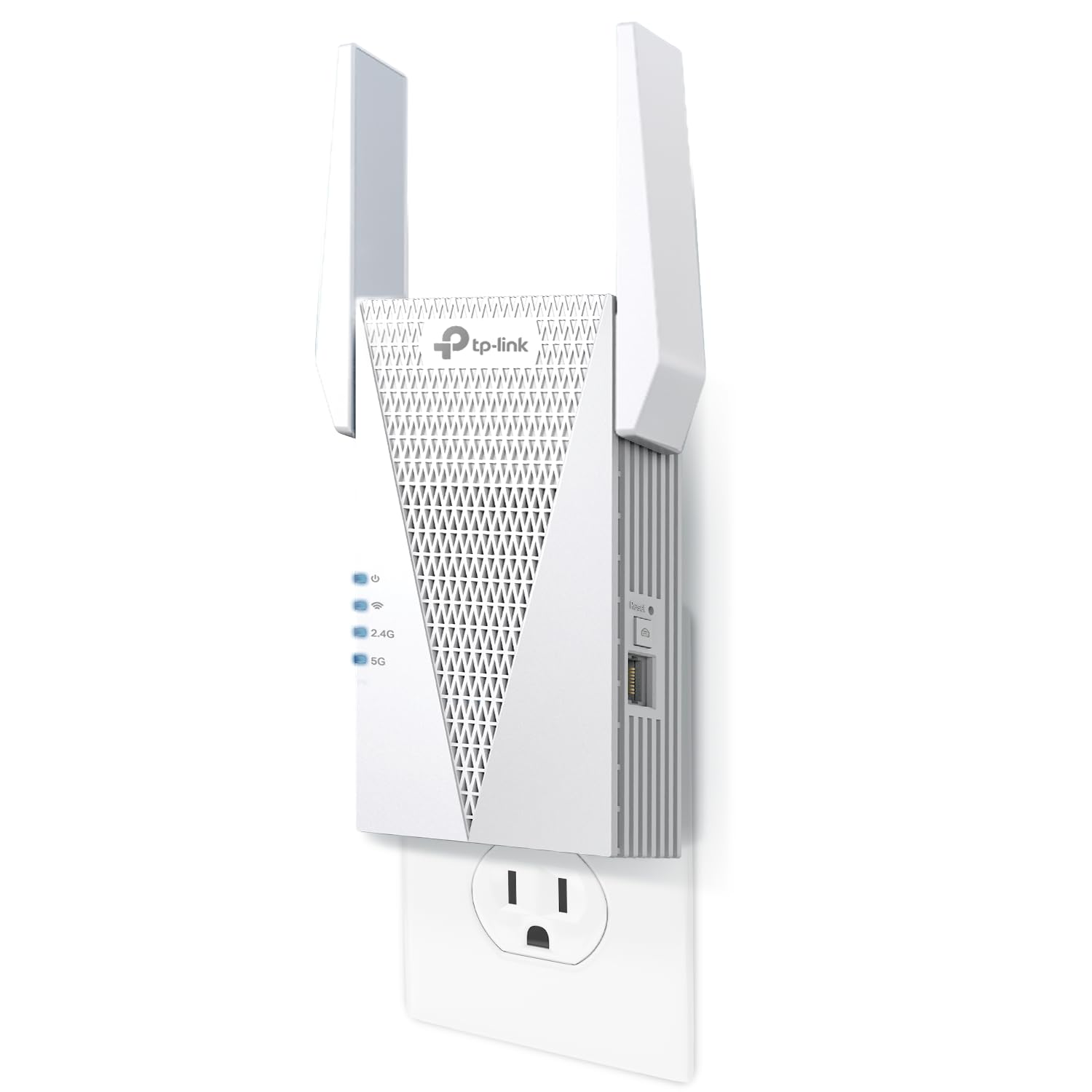
1,000+ ratings
Read Amazon ReviewsTP-Link RE615X
Choose the RE715X if its higher 5 GHz maximum rate and larger stated coverage target better match your layout.
The RE615X is a relevant fit if its lower rate and coverage targets are sufficient for your weak-signal area; its listed feature set also includes Ethernet and EasyMesh.
- The RE615X is a dual-band Wi-Fi 6 extender rated up to 1201 Mbps on 5 GHz and 574 Mbps on 2.4 GHz, with coverage up to 2,100 square feet and support for up to 64 devices.
- It includes a gigabit Ethernet port, Beamforming, EasyMesh compatibility, app setup, and an intelligent signal indicator.
- The RE715X has higher maximum rate ratings and a larger stated coverage figure than the RE615X, while also offering Ethernet and EasyMesh.
Repeaters alternative
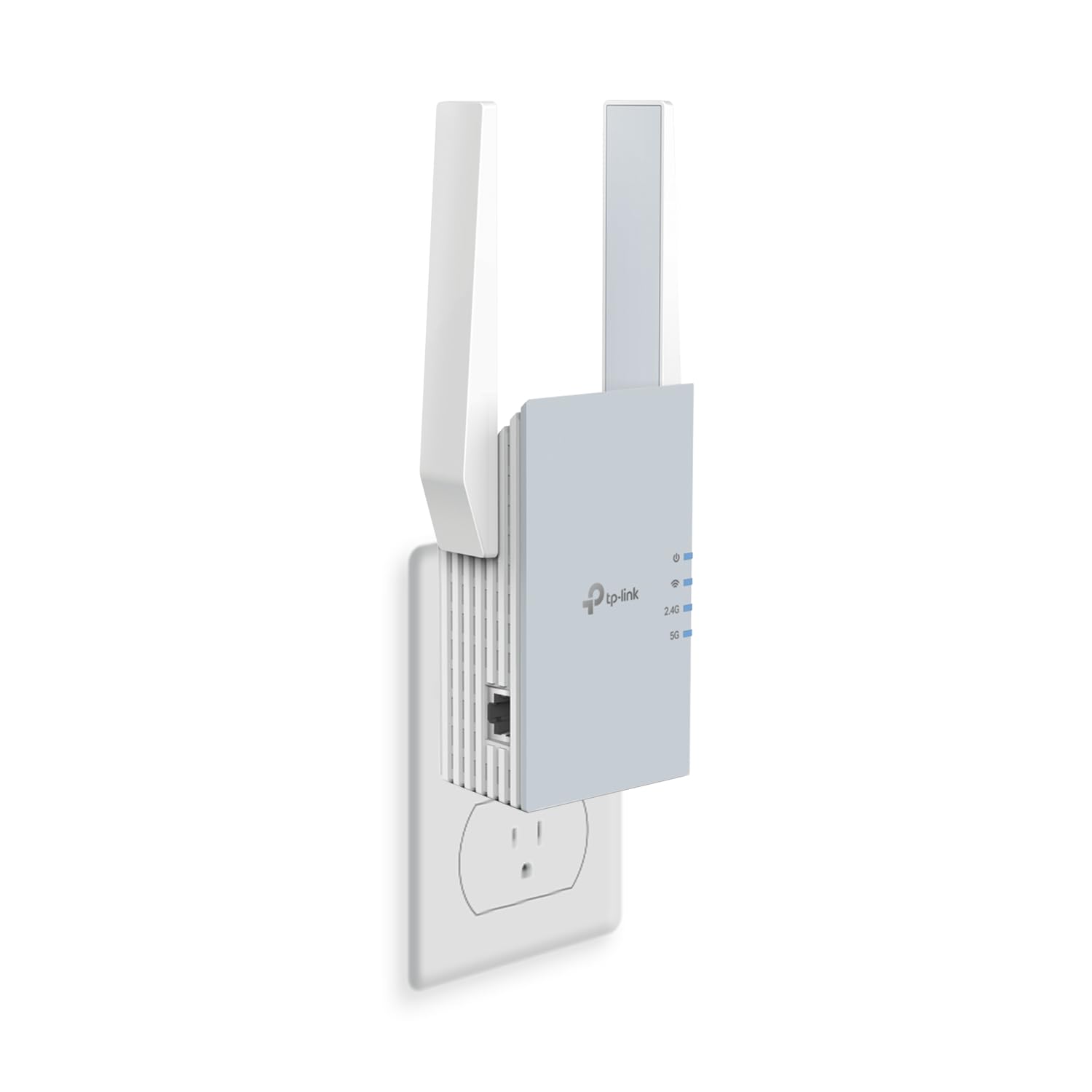
400+ ratings
Read Amazon ReviewsTP-Link RE515X
The RE515X may suit a smaller coverage gap if its lower bandwidth and coverage figures are adequate; it also lists Access Point mode.
Favor the RE715X when you want the higher stated dual-band limits and coverage target, while remembering that placement and the router’s incoming signal constrain either extender.
- The RE515X is a dual-band Wi-Fi 6 extender rated up to 1201 Mbps on 5 GHz and 300 Mbps on 2.4 GHz, with coverage up to 1,800 square feet and support for up to 64 devices.
- Its described features include a gigabit Ethernet port, Access Point mode, EasyMesh compatibility, Smart Adaptive Roaming, and Tether app setup.
- The RE715X is rated up to 2404 Mbps on 5 GHz and 574 Mbps on 2.4 GHz, with coverage up to 2,400 square feet.
Is TP-Link RE715X Worth It?
The TP-Link RE715X is worth considering when a Wi-Fi 6 router already provides a usable signal near the intended extender location and you want to reach a weak-coverage room.
Its directional antennas, Beamforming, gigabit Ethernet, app-guided placement, and EasyMesh support give it several practical ways to fit into a home network.
Buy it for broader coverage, not a faster internet plan or guaranteed full-speed service at the edge of the house.
Check EasyMesh compatibility with your router, rule out Deco if that is your system, and plan to test placement between the router and the area you want to cover.
Your review at a glance
4,000+ ratings
Read Amazon ReviewsTP-Link RE715X
A Wi-Fi 6 range extender for households seeking broader coverage, EasyMesh compatibility, and a wired connection option for a nearby device.
- Dual-band Wi-Fi 6 with maximum rated speeds up to 2404 Mbps on 5 GHz and up to 574 Mbps on 2.4 GHz.
- Coverage figure of up to 2,400 square feet and support for up to 64 devices.
- Two high-gain directional antennas and Beamforming technology for extending the signal.
- EasyMesh compatibility with compatible routers; not compatible with mesh systems such as Deco.